


High-Functioning Burnout: Why Successful Leaders Burn Out Before Anyone Notices
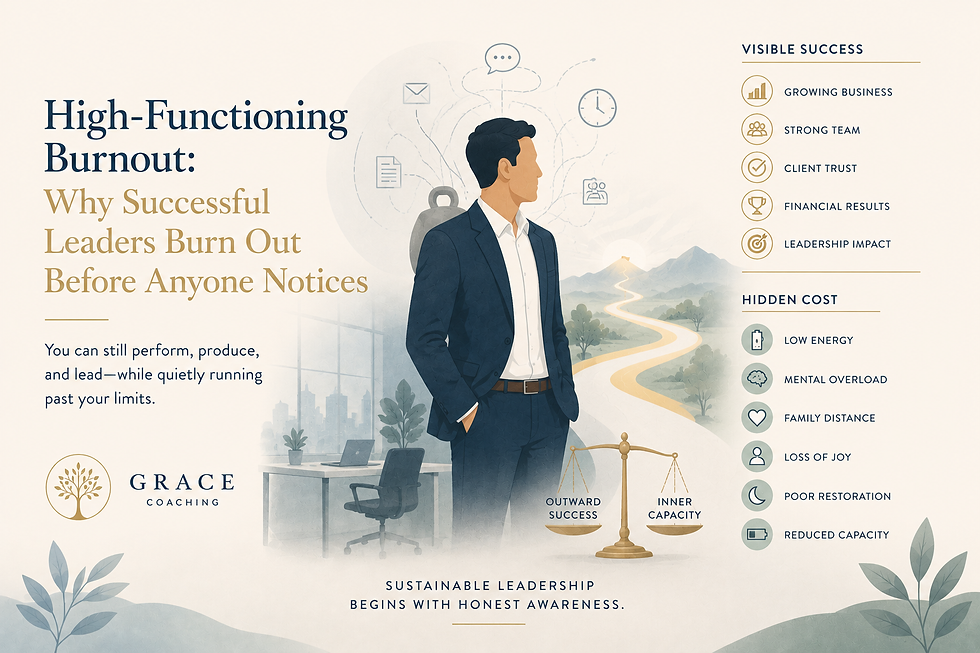
Many successful leaders do not recognize burnout because they are still functioning.
The business is still running.
The team is still being led.
Clients are still being served.
Bills are still being paid.
Decisions are still being made.
Problems are still being solved.
People still see them as capable, responsible, and strong.
From the outside, things may look fine.
Maybe even impressive.
But inside, the leader knows something is different.
They are more tired than they want to admit.
Their patience is thinner.
Their focus is harder to access.
Their creativity feels lower.
Their body feels more tense.
Their mind rarely feels quiet.
Their family gets what is left, not what is best.
Their work still gets done, but joy is harder to find.
They can still perform, but they do not feel fully present.
This is one of the most overlooked forms of burnout:
High-functioning burnout.
It does not always look like collapse.
Sometimes it looks like success.
Burnout Does Not Always Begin With Failure
Many people imagine burnout as someone who can no longer get out of bed, cannot work, cannot lead, and has completely shut down.
That can happen.
But many leaders experience burnout long before anyone around them sees obvious collapse.
They keep moving.
They keep producing.
They keep showing up.
They keep carrying responsibility.
They keep making things work.
That is why high-functioning burnout can be so difficult to detect.
The leader’s performance hides the leader’s depletion.
They are not failing externally, so they assume they must be okay internally.
But performance is not the same as capacity.
You can still perform while your emotional capacity is shrinking.
You can still lead meetings while your patience is fading.
You can still make decisions while your mental clarity is declining.
You can still grow a business while your body is carrying too much stress.
You can still look strong while slowly losing connection with yourself, your family, and your sense of peace.
Burnout does not always begin when performance collapses. Sometimes it begins when performance continues, but the person inside is disappearing.
High-Functioning Burnout Hides Behind Competence
One reason successful leaders burn out before anyone notices is because they are capable.
They know how to push through.
They know how to solve problems.
They know how to manage pressure.
They know how to keep people moving.
They know how to take responsibility.
They know how to make things happen even when they are tired.
These strengths may be part of why they became successful.
But the same strengths can also become dangerous when they are used without recovery, boundaries, support, or honest self-awareness.
A high-capacity leader can carry a heavy load for a long time.
But carrying something for a long time does not mean it is not costing them.
Competence can hide the cost.
The leader may say:
“I’m fine.”
“It’s just a busy season.”
“This is what it takes.”
“I’ll rest when things slow down.”
“Other people are counting on me.”
“I can handle it.”
“I do not have time to slow down right now.”
Sometimes those statements are true for a season.
But when they become a way of life, the leader may slowly begin normalizing a level of pressure they were never meant to carry indefinitely.
The Early Signs Are Often Subtle
High-functioning burnout usually does not announce itself loudly at first.
It often begins quietly.
You may notice you are more easily irritated.
Small problems feel bigger than they should.
You have less patience for questions, mistakes, delays, or normal human needs.
You may feel emotionally flat.
Things that used to feel meaningful now feel like obligations.
You may struggle to focus.
Your mind jumps from one open loop to another without settling.
You may feel tired even after sleeping.
Your body rests, but your nervous system does not fully recover.
You may become more controlling.
Because your capacity is lower, uncertainty feels more threatening.
You may avoid decisions.
Not because you are incapable, but because your mind is already carrying too much.
You may become less present at home.
You are physically there, but mentally still solving business problems.
You may lose joy in the very business you worked hard to build.
These signs are easy to dismiss because they do not always stop the leader from performing.
But they matter.
They are early warnings that the leader’s current load may be exceeding their sustainable capacity.
Functioning Is Not the Same as Flourishing
A leader can function for a long time without flourishing.
Functioning means you are getting through the day.
Flourishing means you are living and leading with enough internal capacity to be clear, present, purposeful, connected, and restored.
Functioning asks:
“Did I get it done?”
Flourishing asks:
“What is this costing me?”
Functioning asks:
“Can I keep going?”
Flourishing asks:
“Am I becoming the kind of person I want to be while I keep going?”
Functioning asks:
“Is the business still working?”
Flourishing asks:
“Is my life still working?”
Many leaders are rewarded for functioning.
They are praised for producing, solving, leading, and sacrificing.
But few people ask whether the leader is still well.
That is why successful leaders need to ask themselves the questions others may not ask.
Am I still emotionally available to the people I love?
Am I leading with clarity or just urgency?
Am I making thoughtful decisions or simply reacting?
Am I proud of the business but disconnected from my life?
Am I using productivity to avoid feeling how tired I really am?
Am I still enjoying any part of what I have built?
These are not soft questions. They are leadership questions.
Because the condition of the leader eventually affects everything the leader carries.
Burnout Often Shows Up in Relationships First
Before burnout shows up in business performance, it often shows up in relationships.
A leader may still be effective at work but less patient at home.
They may give their best emotional energy to clients, employees, vendors, and problems, then come home with very little left.
They may become short with their spouse.
Distant with their children.
Less interested in connection.
More easily irritated.
Less able to listen.
More likely to escape into a phone, food, television, work, alcohol, or distraction.
This does not mean the leader does not love their family.
It may mean the leader has been spending more emotional capacity than they are recovering.
The people closest to the leader often feel the cost before the outside world sees it.
That is one of the painful realities of high-functioning burnout.
The business may still receive performance. The family may receive depletion.
This is not about shame.
It is about awareness.
Because once a leader sees the pattern, they can begin to change how they carry success.
Burnout Also Affects Communication
When capacity is low, communication changes.
The leader may become sharper.
They may avoid hard conversations because they do not have the energy for them.
They may overreact to small issues.
They may become less clear.
They may assume motives more quickly.
They may be more impatient with questions.
They may delay feedback until frustration builds.
This is why communication struggles are often connected to capacity struggles.
A leader who is deeply depleted may know how to be direct without being harsh, but in the moment they have less emotional room to practice it.
They may know what good leadership looks like, but their internal capacity is too strained to consistently access it.
This matters because leadership communication is not only about skill.
It is also about state.
A tired, overloaded, pressured leader will communicate differently than a rested, clear, grounded leader.
That is why burnout is not only a personal wellness issue.
It becomes a leadership issue.
Mental Overload Is One of the Hidden Drivers
High-functioning burnout is not only caused by long hours.
It is often caused by long-term mental overload.
The mind is carrying too many unresolved things.
Unmade decisions.
Unfinished conversations.
Unclear priorities.
Repeated team issues.
Financial pressure.Family concerns.
Health questions.Strategic uncertainty.
Expectations from others.
Expectations from yourself.
This connects directly to the hidden weight of unmade decisions. A leader may not be physically doing all the work at every moment, but they may still be carrying dozens of open loops internally.
That kind of carrying is exhausting.
It makes rest harder.
It makes focus harder.
It makes presence harder.
It makes peace harder.
A leader can take a day off physically and still not feel restored because the mind has not released the weight.
This is why burnout recovery requires more than taking a break.
The leader must also address what they are carrying, why they are carrying it, and what needs to change in the system around them.
“This Is Just a Busy Season” Can Become a Dangerous Story
Every leader has busy seasons.
There are launches, transitions, staffing issues, financial pressures, growth phases, family needs, and unexpected challenges.
Busy seasons are normal.
The danger comes when every season becomes a busy season.
The leader keeps saying:
“After this project.”
“After this hire.”
“After this quarter.”
“After we stabilize.”
“After the kids’ schedule settles down.”
“After we hit this revenue goal.”
“After we get through this problem.”
But when that future relief never arrives, the leader may need to stop asking:
“When will things calm down?”
And start asking:
“What structure am I missing that keeps making every season feel unsustainable?”
Sometimes the problem is not the season.
Sometimes the problem is the system.
A business that depends too much on the leader will keep creating pressure for the leader.
A calendar with no recovery rhythm will keep draining the leader.
A team without enough ownership will keep pulling decisions back to the leader.
A leader without boundaries will keep saying yes beyond capacity.
A life without restoration will eventually feel like a machine.
Busy seasons happen.
But sustainable leadership requires a rhythm that does not depend on the fantasy that life will someday stop being demanding.
The Body Often Tells the Truth Before the Leader Does
Many leaders are trained to override their bodies.
They ignore fatigue.
They push through tension.
They normalize poor sleep.
They dismiss headaches, stomach issues, tightness, irritability, restlessness, or shallow breathing.
They keep going because people need them.
But the body often tells the truth before the leader is willing to say it.
The body may say:
“This pace is too much.”
“This pressure has been here too long.”
“You are not recovering.”
“You are living in constant activation.”
“You are carrying more than you admit.”
This does not mean every physical symptom is caused by leadership pressure. Medical concerns should always be handled with proper medical care.
But it does mean leaders should pay attention when the body repeatedly signals strain.
The body is part of leadership capacity.
A leader does not lead apart from their body.
They lead through it.
Their energy, nervous system, sleep, health, emotions, and ability to recover all shape how they show up.
Ignoring the body may work for a while.
But eventually the body asks to be included in the leadership conversation.
High-Functioning Burnout Often Has an Identity Component
For many leaders, burnout is not only about workload.
It is about identity.
They may believe:
“I am the one who has to carry it.”
“If I slow down, things will fall apart.”
“My value comes from being needed.”
“I cannot disappoint people.”
“I have to be strong.”
“I should be able to handle this.”
“If I am not producing, I am falling behind.”
“If I let go, I may lose control.”
These beliefs can keep a leader trapped in patterns that look responsible but become unsustainable.
This is why burnout cannot always be solved by better scheduling alone.
The leader may need to examine the deeper beliefs that keep them overextended.
A calendar change will not last if the identity underneath still says:
“I am only safe, valuable, or respected when I am carrying everything.”
This is where burnout becomes a self-leadership issue.
The leader must learn not only to manage time, but to lead the internal patterns that keep them overloaded.
The Cost of Ignoring High-Functioning Burnout
Ignoring burnout does not make it disappear.
It usually spreads.
First, it affects internal energy.
Then focus.
Then patience.
Then communication.
Then relationships.
Then health.
Then leadership judgment.
Then business culture.
A leader who runs too long on depletion may still be making decisions, but those decisions may become more reactive, controlling, delayed, or emotionally driven.
They may become less creative.
Less relational.
Less courageous.
Less discerning.
Less able to separate signal from noise.
They may become successful at maintaining motion while losing the ability to lead from clarity.
That is why high-functioning burnout deserves attention before collapse.
The best time to address burnout is not after everything breaks.
The best time is when the signs begin to appear.
A Reflection for Leaders
Take a few minutes and answer these questions honestly.
Where am I still performing but no longer feeling restored?
What part of my life is receiving what is left over from me?
Where has my patience become thinner?
What decisions, conversations, or responsibilities am I carrying in the background?
What am I calling a busy season that may actually be an unsustainable rhythm?
What does my body keep trying to tell me?
Where am I confusing functioning with flourishing?
What would need to change for me to lead with more capacity, not just more effort?
These questions are not meant to create guilt.
They are meant to create honesty.
Burnout loses some of its power when it is named clearly.
What Leaders Need Instead of Just Pushing Through
High-functioning leaders often try to solve burnout by pushing harder, organizing better, or waiting for a break.
But sustainable change usually requires more than that.
The leader may need:
Clearer priorities.
Better boundaries.
More honest conversations.
A stronger recovery rhythm.
More team ownership.
Less dependence on the founder.
A better way to close open loops.
A healthier relationship with responsibility.
A clearer distinction between what is theirs to carry and what is not.
A leadership structure that protects capacity instead of constantly spending it.
This is not about becoming less committed.
It is about becoming more sustainable.
The goal is not to lower the leader’s standards.
The goal is to stop sacrificing the leader’s life, health, and relationships in order to maintain the standards.
Strong leadership should produce more than business results.
It should also produce a life the leader can actually live.
Things to Remember
High-functioning burnout is dangerous because it hides behind success.
The leader is still performing, so people assume they are fine.
The business is still moving, so the pressure seems normal.
The results are still coming, so the cost is easy to ignore.
But the leader knows.
They know when joy is fading.
They know when their family is getting less of them.
They know when their patience is thinner.
They know when their body feels constantly tense.
They know when their mind never fully rests.
They know when they are functioning but not flourishing.
That awareness matters. It may be the signal that something needs to change.
Not because the leader is weak.
But because the current way of carrying success may no longer be sustainable.
Burnout does not mean you have failed.
It may mean your leadership, business, and life need a new structure for the weight you are carrying.
If you are still performing but quietly running past your limits, take the Leadership Capacity Assessment to identify where pressure may be building and what may need to shift next.
Still Performing, But Quietly Running Past Your Limits?
High-functioning burnout can be hard to recognize because the outside still looks successful. But if your focus, patience, health, relationships, or peace are paying the price, it may be time to examine where pressure is building.
Take the Leadership Capacity Assessment to identify what may be draining your capacity and what kind of support may help you lead with greater clarity and sustainability.


