When Your Leadership Style Follows You Home

Many leaders do not leave work at work.
They may leave the building.
They may close the laptop.
They may get in the car.
They may sit at the dinner table.
They may walk into the house.
But internally, they are still carrying the posture of leadership.
They are still solving.
Still evaluating.
Still anticipating problems.
Still thinking three steps ahead.
Still holding responsibility.
Still managing pressure.
Still scanning for what needs to be corrected, improved, completed, or controlled.
At work, those instincts may help them succeed.
They can make decisions.
They can handle pressure.
They can identify gaps.
They can hold standards.
They can lead people through complexity.
They can move things forward.
But when those same patterns follow the leader home without adjustment, they can create distance in the very relationships that matter most.
A spouse may feel managed instead of understood.
Children may feel corrected instead of connected with.
The home may begin to feel like another place where performance is expected.
The leader may be physically present, but emotionally still in command mode.
This is one of the hidden costs of leadership pressure:
The style that helps you lead the work can sometimes weaken your ability to love the people closest to you.
Your Strengths at Work Can Become Pressure at Home
Most leaders do not intend to bring workplace pressure into their family.
They are not trying to treat their spouse like an employee.
They are not trying to make their children feel like projects.
They are not trying to turn dinner into a performance review.
They are often trying to help.
Trying to solve.
Trying to protect.
Trying to improve things.
Trying to make life easier.
Trying to prevent problems.
Trying to keep everything moving.
But the same behavior can feel different depending on the relationship.
At work, direct correction may be necessary.
At home, constant correction can feel like criticism.
At work, efficiency may be valued.
At home, efficiency without warmth can feel cold.
At work, decision-making may create momentum.
At home, quick decisions without listening can feel dismissive.
At work, high standards may protect quality.
At home, high standards without grace can create tension.
At work, problem-solving may be respected.
At home, solving too quickly can make people feel unheard.
This does not mean your leadership strengths are wrong.
It means they need to be adapted.
The home is not led the same way the business is led.
Your Spouse Is Not an Employee
This may seem obvious, but many leaders unintentionally forget it in the moment.
A spouse does not primarily need to be managed, corrected, optimized, or directed.
They need partnership.
They need emotional presence.
They need to feel heard.
They need to know they matter beyond what they do.
They need the leader to be a person, not only a performer.
In business, a leader may ask:
“What is the issue?”
“What is the solution?”
“What is the next step?”
“What needs to change?”
Those are useful questions in the right context.
But at home, a spouse may be looking for different questions.
“How are you really doing?”
“What has today been like for you?”
“What do you need from me right now?”
“Do you want me to listen, help, or simply be with you?”
“Where have I been missing you?”
“How can we reconnect?”
When a leader treats every emotional moment like a problem to solve, the spouse may stop sharing.
Not because they do not want connection.
But because they do not want to become another issue on the leader’s agenda.
Your Children Need Presence More Than Performance
Children experience leadership differently than adults do.
They may not have language for it, but they can feel when a parent is distracted, hurried, irritated, or emotionally unavailable.
A leader may provide well, work hard, create opportunities, and make sacrifices for the family.
Those things matter.
But children also need the experience of being enjoyed.
They need a parent who can slow down enough to notice them.
They need connection that is not always instructional.
They need play, attention, warmth, curiosity, and patience.
They need to know they are not interruptions to the more important work.
For a high-performing leader, this can be difficult.
Children are inefficient.
They tell long stories.
They ask repeated questions.
They make messes.
They move slowly.
They have big emotions at inconvenient times.
They do not always respond to logic, timelines, or adult priorities.
But this is part of the invitation of family.
Home asks the leader to become more than productive. It asks them to become present.
The Home Cannot Become Another Performance Environment
Many successful leaders live in a world of measurement.
Revenue.
Profit.
Deadlines.
Client satisfaction.
Employee performance.
Growth.
Efficiency.
Execution.
Progress.
Those measurements are useful in business.
But if the leader carries that same measurement mindset home, family life can become heavy.
The spouse may feel evaluated.
The children may feel judged.
The leader may feel frustrated because home does not run like a business.
There are dishes, emotions, delays, needs, clutter, plans that change, and people who do not always move according to the leader’s preferred pace.
A home is not healthy because it runs perfectly.
A home is healthy when people feel safe, loved, respected, known, and connected.
That does not mean standards disappear.
Families need responsibility, structure, communication, and follow-through too.
But the spirit is different.
At home, the goal is not only completion.
The goal is connection.
Leadership Pressure Often Follows the Leader Home
If a leader is overloaded at work, home often receives the overflow.
This may look like irritability.
A short tone.
A distracted mind.
A lack of patience.
A desire to be left alone.
A constant need to check messages.
An inability to transition.
A tendency to correct small things.
A feeling that family needs are another demand.
This does not mean the leader does not care about their family.
It often means their capacity has been spent before they arrived home.
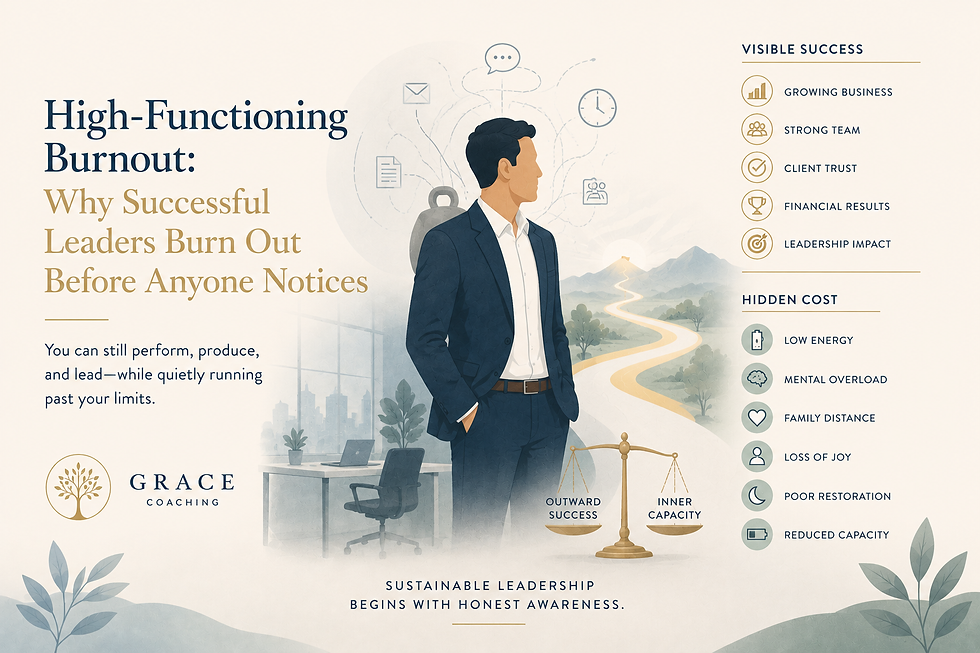
This connects closely to high-functioning burnout. A leader can still perform publicly while privately becoming less available to the people they love most.
The business may receive the leader’s best focus.
The family may receive the leader’s leftover capacity.
That is painful to admit, but important to notice.
Because what is noticed can be changed.
The Transition From Work to Home Matters
Many leaders need a transition ritual.
Without one, they walk straight from work pressure into family interaction.
The body is home, but the nervous system is still at work.
The mind is still solving.
The tone is still sharp.
The posture is still guarded.
The pace is still rushed.
A transition ritual helps the leader shift from command mode into connection mode.
It does not need to be complicated.
It may be five minutes in the car before walking inside.
A short walk.
A few deep breaths.
A written list of what is still open at work so the mind does not keep carrying it.
A prayer.
A moment to ask:
“What version of me does my family need right now?”
That question is powerful.
Not because it creates perfection.
But because it creates intention.
A leader who pauses before entering the home is more likely to bring presence instead of pressure.
Problem-Solving Is Not Always Connection
Many leaders show love by solving problems.
This is not wrong. Solving can be generous.
It can be protective.
It can be helpful.
But problem-solving is not always what the relationship needs first.
Sometimes the person wants to be understood before being advised.
A spouse may share frustration and need empathy before strategy.
A child may express fear and need comfort before correction.
A teenager may complain and need curiosity before a lecture.
A family member may need your presence before your plan.
This does not mean leaders should never offer solutions.
It means timing matters.
Connection first often makes correction and solution more effective later.
A simple question can help:
“Do you want me to listen, help solve, or just be with you right now?”
That question can change the entire interaction.
It tells the other person:
“I am not here to take over. I am here to understand what you need.”
Directness at Home Requires Even More Care
Leaders still need to communicate clearly at home.
Avoiding issues in marriage or family life is not healthy.
But directness at home requires care, tenderness, and humility.
In business, direct communication may focus on standards, expectations, outcomes, and next steps.
At home, direct communication also has to protect the bond.
This connects to the leadership skill of being direct without being harsh.
A leader may need to say:
“I realize I have been coming home distracted, and that has affected you.”
“I want to talk about how we are handling evenings because I can feel us getting disconnected.”
“I need to share something honestly, but I do not want to come across like I am blaming you.”
“I think I have been bringing work pressure into the house, and I want to change that.”
This kind of communication is clear, but it is also relational.
It does not only tell the truth.
It takes responsibility for how the truth is delivered.
High Standards Need Grace at Home
High standards can be a gift.
They help leaders build, improve, protect, and grow.
But at home, high standards must be held with grace.
Without grace, standards become pressure.
A child’s messy room becomes a character flaw.
A spouse’s different pace becomes incompetence.
A family delay becomes disrespect.
A small inconvenience becomes a larger emotional reaction.
Grace does not mean lowering every standard.
It means remembering the humanity of the people involved.
It means asking:
“Is this moment asking for correction, connection, patience, humor, or perspective?”
Not everything needs the same response.
Some moments need a standard.
Some need a hug.
Some need a conversation.
Some need rest.
Some need laughter.
Some need the leader to let go of control.
Wisdom is knowing the difference.
The Leader May Need to Apologize Without Defending
One of the most powerful things a leader can do at home is apologize clearly.
Not vaguely.
Not defensively.
Not with a hidden explanation attached.
But with ownership.
“I was short with you. That was not okay.”
“I brought work pressure into our conversation.”
“I corrected you when I should have listened first.”
“I have been distracted lately, and I know that affects our family.”
“I am sorry I made you feel like another problem to solve.”
Apology does not weaken leadership. It strengthens trust.
At work and at home, people can often handle imperfection better than they can handle defensiveness.
A leader does not need to be perfect to build a healthy home.
But they do need to be repairable.
The Goal Is Not to Stop Being a Leader
Some people hear this and think:
“So I should stop leading at home?”
Not exactly.
Your family still needs leadership.
They need responsibility.
They need steadiness.
They need protection.
They need direction.
They need communication.
They need wisdom.
They need follow-through.
They need emotional maturity.
But leadership at home looks different.
At work, leadership often moves people toward performance and outcomes.
At home, leadership moves people toward love, safety, growth, connection, and shared responsibility.
At work, leadership may ask, “How do we execute?”
At home, leadership may ask, “How do we stay connected while we grow?”
At work, leadership may focus on progress.
At home, leadership must also focus on presence.
The leader does not need to stop leading.
They need to lead the home with a different spirit.
A Reflection for Leaders
Take a few minutes and ask yourself honestly:
What part of my work leadership style follows me home?
Do I correct more than I connect?
Do I listen to understand, or do I listen to solve?
Does my family experience me as present or preoccupied?
Where does my spouse feel managed instead of partnered with?
Where do my children experience my pressure more than my presence?
Do I come home with enough emotional capacity to be kind?
What transition do I need between work and home?
Where do I need to apologize or repair?
What would it look like to bring the best of my leadership home without bringing the pressure of work home?
These questions are not meant to create shame.
They are meant to create awareness.
A leader who becomes aware can begin to choose differently.
A Simple Practice: The Home Arrival Reset
Before walking into your home, pause for one minute.
Ask yourself:
What am I still carrying from work?
Can I write it down or name it so I do not bring it into the room unconsciously?
What emotional state am I in?
What does my family need from me tonight?
What is one way I can show presence in the first ten minutes?
Then choose one intentional action.
Put the phone away for twenty minutes.
Greet your spouse with attention.
Ask your child one question and listen without multitasking.
Change clothes and mentally mark the shift.
Take three slow breaths before entering.
Say a short prayer.
This practice is simple, but it matters.
The first few minutes at home often set the tone for the evening.
Things to Remember
The leadership style that helped you succeed at work may not automatically create connection at home.
Your decisiveness may need to become patience.
Your problem-solving may need to become listening.
Your standards may need to be held with grace.
Your direction may need to become partnership.
Your ability to carry responsibility may need to include the humility to be emotionally present.
Your spouse and children do not need the executive version of you.
They need the present version of you.
The one who listens.
The one who notices.
The one who can repair.
The one who can laugh.
The one who can put down the weight long enough to connect.
This does not mean business stops mattering.
It means the life behind the business matters too.
If leadership pressure has been following you home, this may be a sign that the way you are carrying success needs to be redesigned.
Explore Private Advisory to learn how Grace Coaching helps founders and executives lead the business without losing connection with the life and relationships that matter most.
Is Leadership Pressure Following You Home?
If work stress is affecting your marriage, family presence, patience, or ability to fully disconnect, the answer may not be simply trying harder to “balance it all.”
Private Advisory helps founders and executives redesign how they carry leadership pressure so they can lead the business without losing connection at home.