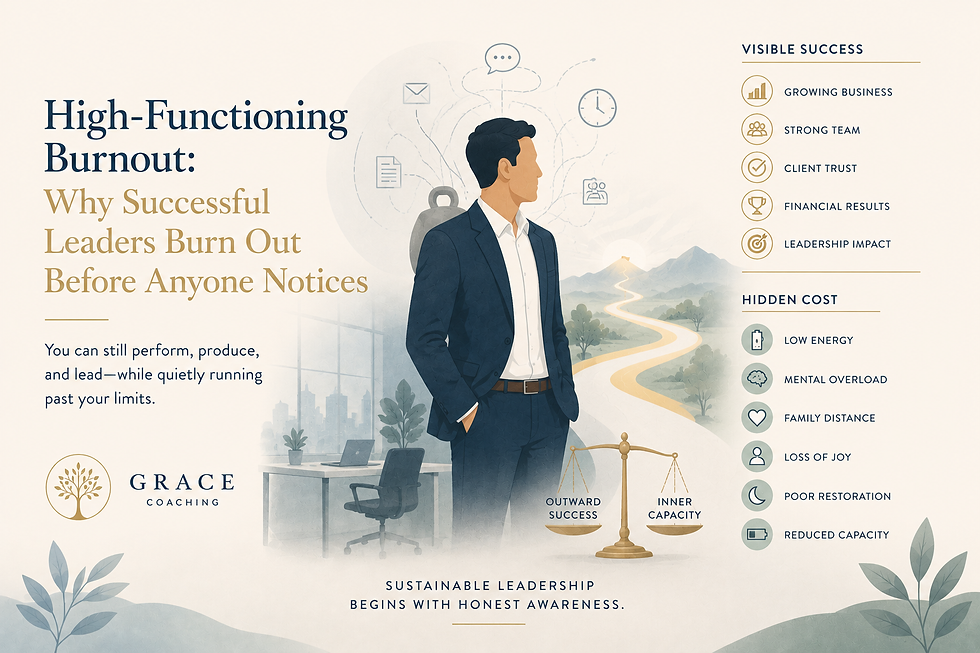
You May Not Need More Time. You May Need More Capacity.

Many leaders believe their main problem is time.
They say:
“I need more hours in the day.”
“I need a better schedule.”
“I need fewer interruptions.”
“I need to get more organized.”
“I need to manage my calendar better.”
“I need to be more disciplined.”
Sometimes they are right.
Time management matters. Calendars matter. Priorities matter. Boundaries matter. A poorly designed week can create unnecessary pressure for any leader.
But time is not always the real issue.
Sometimes the deeper issue is capacity.
A leader may technically have time on the calendar but no mental room to think clearly.
They may have an open evening but no emotional energy left for their family.
They may have a quiet morning but no creative capacity to solve the problem that matters.
They may have a weekend off but still feel tense, restless, distracted, and unable to recover.
They may create a better schedule and still feel overwhelmed because the real issue was never only the schedule.
It was the load they were carrying inside the schedule.
This is why many leaders do not only need more time.
They need more capacity.
Time and Capacity Are Not the Same Thing
Time is external.
Capacity is internal.
Time is the number of hours available.
Capacity is your ability to use those hours with clarity, energy, patience, creativity, presence, and wise judgment.
Time asks:
“How many hours do I have?”
Capacity asks:
“What condition am I in while I carry those hours?”
A leader can have time and still feel depleted.
A leader can have a full calendar and still be deeply energized if the work is aligned, supported, and sustainable.
A leader can have a lighter day and still feel overwhelmed if their mind is crowded with unresolved pressure.
This is why time management alone does not always fix leadership fatigue.
A better calendar cannot fully compensate for a depleted nervous system, unclear priorities, unresolved decisions, lack of support, strained relationships, poor recovery, or a business that depends too much on the leader.
Time is the container. Capacity is what determines how well you can carry what is inside it.
The Same Hour Feels Different Depending on Your Capacity
One hour is not always experienced the same way.
An hour of work when you are clear, rested, and focused can be productive and meaningful.
An hour of work when you are mentally overloaded can feel heavy and inefficient.
An hour with your family when you are present can feel restorative.
An hour with your family when your mind is still at work can feel like another demand.
An hour of strategic thinking when you have internal space can produce insight.
An hour of strategic thinking when you are anxious, rushed, and depleted can produce more frustration.
This is why leaders often misdiagnose their problem.
They believe they need more time because the time they have does not feel effective.
But the question may not be:
“How do I find more hours?”
The better question may be:
“What is draining my ability to use the hours I already have well?”
That question leads to a different kind of solution.
More Time Does Not Help If You Fill It With the Same Patterns
Many leaders believe things will improve once the calendar opens up.
But when space appears, they often fill it with the same patterns that created the pressure.
More tasks.
More meetings.
More decisions.
More availability.
More promises.
More problem-solving.
More catching up.
More opportunities.
More obligations.
The issue was not only that they had too little time.
The issue was that they had no clear way to protect capacity.
Without a deeper shift, more time simply becomes more room to carry the same overload.
This is why a vacation may help temporarily but not change the pattern.
A quiet weekend may bring relief, but by Tuesday the leader is back inside the same rhythm.
A better schedule may help for a few weeks, but if the leader keeps saying yes beyond capacity, the pressure returns.
The calendar matters. But the calendar must be supported by clarity, boundaries, systems, recovery, and self-leadership.
Capacity Is Spent in More Ways Than Work
Leaders often count work hours but overlook capacity drain.
A leader may say:
“I only worked eight hours today. Why am I so tired?”
But capacity was being spent all day.
Making decisions.
Managing emotions.
Handling tension.
Switching contexts.
Solving problems.
Absorbing other people’s urgency.
Carrying financial pressure.
Anticipating risk.
Keeping track of details.
Navigating relationships.
Responding to interruptions.
Thinking about family needs.
Holding unresolved conversations in the background.
Not all effort is visible.
Some of the heaviest work a leader does happens internally.
This is why leaders can feel exhausted even when the calendar does not look extreme.
They are not only spending time.
They are spending focus, patience, emotional control, decision power, physical energy, and relational presence.
A calendar may show what you did. It does not always show what it cost you.
Mental Overload Reduces Capacity
One of the greatest drains on leadership capacity is mental overload.
The mind can only hold so much before clarity begins to suffer.
When a leader is carrying too many unresolved issues, even simple tasks feel heavier.
An unanswered email may feel like pressure.
A normal staff question may feel like interruption.
A small change in schedule may feel frustrating.
A decision that should take five minutes may feel exhausting.
This is not always because the leader is weak.
It may be because their mental bandwidth is already full.
This connects to the weight of unmade decisions. Every unresolved decision becomes an open loop, and too many open loops reduce the leader’s available capacity.
The leader is not only doing today’s work.
They are carrying yesterday’s unfinished decisions and tomorrow’s possible consequences.
That kind of mental load makes time feel smaller than it is.
Emotional Depletion Changes How Leadership Feels
Emotional capacity matters too.
A leader with emotional capacity can handle tension without immediately becoming reactive.
They can listen without feeling overwhelmed.
They can correct without becoming harsh.
They can make decisions without spiraling into fear.
They can be present with family after a demanding day.
They can carry responsibility without losing themselves inside it.
But when emotional capacity is low, everything feels more personal, more urgent, and more threatening.
Small mistakes feel bigger.
Feedback feels heavier.
Conflict feels more exhausting.
Requests feel like demands.
Uncertainty feels unsafe.
People’s needs feel like pressure.
This is often when leaders become sharper, more avoidant, more controlling, or more withdrawn.
They may think the problem is the people around them.
Sometimes it is.
But sometimes the deeper issue is that the leader has been running on reduced emotional capacity for too long.
Physical Capacity Is Leadership Capacity
Many leaders treat the body as if it is separate from leadership.
It is not.
Your body is part of how you lead.
Your sleep affects your patience.
Your nutrition affects your energy.
Your movement affects your mood.
Your stress level affects your decision-making.
Your breathing affects your nervous system.
Your recovery affects your presence.
Your health affects your leadership range.
A leader cannot consistently ignore the body and expect the mind, emotions, and relationships to remain unaffected.
This does not mean leaders need to become perfectionistic about health.
It means they need to respect the connection between physical capacity and leadership performance.
When your body is under-recovered, your leadership capacity shrinks.
You may still function.
You may still perform.
You may still get through the day.
But as we discussed in high-functioning burnout, functioning is not the same as flourishing.
Relationship Strain Reduces Capacity
Relationships can either restore capacity or drain it.
When things are disconnected at home, a leader carries that into work.
When marriage is tense, parenting feels strained, friendships are neglected, or family time is low-quality, the leader may feel emotionally divided.
They may work hard to succeed externally while feeling quietly unsettled internally.
Many leaders underestimate how much relational disconnection affects their focus, patience, and peace.
A business owner may believe the problem is workload, but part of the pressure may be that life outside the business no longer feels restoring.
This is why work-life integration matters.
Not because every area of life gets equal time every day.
But because a leader’s life cannot be treated as disconnected compartments forever.
The condition of the person affects the quality of the leadership.
A leader who is relationally depleted may still lead, but they are carrying an invisible cost.
The Business System Can Drain or Restore Capacity
Capacity is not only personal. It is also structural.
Some businesses are designed in a way that constantly drains the owner.
Too many decisions run through the founder.
Too many people need approval.
Too many processes are unclear.
Too many meetings are reactive.
Too much knowledge lives in the owner’s head.
Too many problems repeat.
Too many priorities compete.
Too many roles are undefined.
In that kind of system, the leader may keep asking for more time when what they really need is a better leadership structure.
If the business is designed to depend on the leader’s constant involvement, the leader’s capacity will keep being spent faster than it is restored.
This is why capacity work often includes systems work.
A leader does not only need to rest from pressure. They need to redesign the sources of repeated pressure.
More Capacity Creates Better Time
When capacity improves, time feels different.
A clear mind uses time better.
A rested body moves through work differently.
An emotionally steady leader communicates more effectively.
A leader with defined priorities makes decisions faster.
A leader with stronger boundaries protects the calendar more wisely.
A leader with better systems gets interrupted less.
A leader with restored relationships comes home differently.
A leader with a clearer identity does not say yes to everything in order to feel valuable.
Capacity does not replace time management. It makes time management work better.
Without capacity, even a well-designed calendar can feel heavy.
With capacity, the same calendar may feel more manageable, purposeful, and grounded.
How to Tell If You Have a Time Problem or a Capacity Problem
Here are a few questions to help you diagnose the difference.
You may have a time problem if:
Your calendar is objectively overfilled.
You have too many meetings.
You have no blocks for focused work.
You are committing to more than the week can realistically hold.
You are spending time on low-value tasks that should be delegated or eliminated.
You may have a capacity problem if:
You have time available but still feel unable to think clearly.
You are physically present at home but emotionally unavailable.
You take time off but do not feel restored.
Small things feel heavier than they should.
You keep avoiding decisions or conversations.
Your patience, creativity, and focus feel lower than usual.
You feel tired even when the calendar does not fully explain the tiredness.
Most leaders have some combination of both.
But it matters which problem is primary.
If the problem is time, improve the calendar.
If the problem is capacity, the calendar alone will not be enough.
A Simple Capacity Audit
Take a few minutes and rate yourself from 1 to 10 in these areas.
Mental clarity.
Emotional steadiness.
Physical energy.
Relational connection.
Recovery rhythm.
Decision confidence.
Spiritual or purpose alignment.
Focus and attention.
Patience with people.
Joy in the work.
Then ask:
Where is my capacity lowest right now?
What is draining that area?
What have I been calling a time problem that may actually be a capacity problem?
What would restore capacity in that area?
What needs to be removed, clarified, delegated, repaired, scheduled, or changed?
What pattern keeps spending my capacity faster than I recover it?
This kind of audit gives a leader more than a productivity plan.
It gives them a fuller view of what leadership is costing and what needs to be restored.
Capacity Requires Recovery, But Not Only Recovery
Rest matters.
Sleep matters.
Vacations matter.
Quiet matters.
Time away matters.
But capacity is not restored only by rest.
Sometimes capacity is restored by clarity.
A decision finally made.
A hard conversation finally held.
A boundary finally communicated.
A process finally created.
A role finally clarified.
A responsibility finally delegated.
A priority finally chosen.
A relationship finally repaired.
A truth finally admitted.
This is important because many leaders try to rest while still carrying unresolved pressure.
Their body stops, but their mind keeps working.
Their calendar opens, but the internal loops stay active.
The leader does not only need rest from work.
They may need resolution around what they have been carrying.
The Goal Is Sustainable Leadership
Capacity work is not about doing less for the sake of doing less.
It is about leading in a way that can be sustained.
A leader may still work hard.
They may still build.
They may still pursue excellence.
They may still carry meaningful responsibility.
But the goal is to stop confusing constant depletion with commitment.
Sustainable leadership asks:
Can I lead this way for the long term?
Is this rhythm producing the kind of life I actually want?
Is my success requiring a version of me that my family rarely gets to enjoy?
Is my business growing while my capacity is shrinking?
What would need to change so the next level does not cost me my health, marriage, peace, or purpose?
These are not luxury questions. They are leadership questions.
Because the leader’s capacity eventually becomes part of the business’s capacity.
Things to Remember
You may not need more time. You may need more capacity.
More mental room.
More emotional steadiness.
More physical energy.
More relational connection.
More recovery.
More clarity.
More boundaries.
More support.
More alignment between what you are building and how you are living.
Time management is useful.
But it cannot fully solve a life that is being carried beyond sustainable capacity.
A better calendar may help you organize the load.
But capacity helps you carry the load differently.
If you have been telling yourself, “I just need more time,” pause and ask a deeper question:
“What kind of capacity do I need to restore so I can lead this season well?”
That question may lead you toward a different kind of solution.
If you are not sure where your capacity is being drained, take the Leadership Capacity Assessment to identify where pressure is building and what may need to shift next.
Is It Really a Time Problem, or a Capacity Problem?
If you have more tasks than space, your calendar may need attention. But if you have time and still feel mentally crowded, emotionally depleted, physically tired, or unable to recover, the deeper issue may be capacity.
Take the Leadership Capacity Assessment to identify where pressure is building and what may need to be restored, clarified, or redesigned.