Lead Yourself First: The Inner Work Behind Strong Leadership

Many leaders learn how to lead a business before they learn how to lead themselves.
They learn how to make decisions.
Manage people.
Solve problems.
Build systems.
Handle pressure.
Grow revenue.
Serve clients.
Set goals.
Create momentum.
Those skills matter.
But over time, many successful leaders discover that the hardest person to lead is not always an employee, client, partner, or team member.
Sometimes the hardest person to lead is the person in the mirror.
The leader’s own emotions.
Their reactions under pressure.
Their habits.
Their fears.
Their need for control.
Their avoidance patterns.
Their identity.
Their relationship with success.
Their ability to rest.
Their ability to tell the truth.
Their ability to stay aligned with what matters most.
This is why strong leadership begins with self-leadership.
You cannot consistently lead others beyond your ability to lead yourself.
Leadership Is Not Only What You Do. It Is Who You Are While You Do It.
Many people think of leadership as action.
Making decisions.
Delegating.
Communicating.
Planning.
Correcting.
Solving.
Directing.
Executing.
Those actions are important.
But leadership is not only what the leader does.
It is also the condition of the person doing it.
Two leaders can have the same conversation and create completely different outcomes.
One communicates with steadiness, clarity, humility, and respect.
The other communicates with irritation, pressure, defensiveness, or control.
The words may even be similar. But the presence is different.
Two leaders can face the same problem.
One becomes curious, strategic, and grounded.
The other becomes reactive, anxious, controlling, or avoidant.
The difference is not only skill.
It is self-leadership.
The inner condition of the leader affects the outer expression of leadership.
Pressure Reveals the Leader’s Inner Operating System
Pressure has a way of revealing what is underneath.
When everything is calm, many leaders can appear patient, thoughtful, and balanced.
But pressure exposes patterns.
It reveals how the leader responds when they feel out of control.
It reveals whether they communicate clearly or become harsh.
It reveals whether they make decisions or delay them.
It reveals whether they trust others or pull everything back to themselves.
It reveals whether they protect what matters or become consumed by urgency.
It reveals whether they lead from values or from fear.
This does not mean pressure is bad.
Pressure can become information.
It shows the leader where growth is needed.
If pressure makes a leader controlling, there may be a deeper trust issue.
If pressure makes a leader avoid conversations, there may be a deeper fear of conflict.
If pressure makes a leader overwork, there may be a deeper belief that their value depends on productivity.
If pressure makes a leader disconnect at home, there may be a deeper capacity issue.
If pressure makes a leader reactive, there may be a need for greater emotional regulation.
The goal is not to shame the leader. The goal is to understand the pattern.
Because what remains unconscious often keeps leading from the background.
Self-Leadership Begins With Awareness
A leader cannot lead what they refuse to see.
Awareness is the beginning of self-leadership.
Not self-condemnation.
Not overthinking.
Not endless self-analysis.
But honest awareness.
A self-led leader can ask:
“What happens inside me when I feel pressure?”
“What patterns do I repeat when I am tired?”
“What kind of leader do I become when I feel criticized?”
“What do I avoid?”
“What do I over-control?”
“What do I carry that I should not carry?”
“What do I say matters most, and what do my choices reveal?”
“What part of my leadership is driven by purpose, and what part is driven by fear?”
These questions take courage.
It is often easier to focus only on strategy, systems, and other people’s behavior.
But leaders who avoid self-awareness eventually become limited by their own blind spots.
A leader’s blind spot does not stay private.
It shows up in the business, the team, the marriage, the family, and the culture they create.
Emotional Regulation Is a Leadership Skill
Leaders do not need to be emotionless.
In fact, emotion is part of being human.
A leader may feel frustration, disappointment, fear, grief, excitement, pressure, hope, anger, or uncertainty.
The goal of self-leadership is not to suppress emotion.
The goal is to steward emotion.
There is a difference.
Suppression says:
“I should not feel this.”
Stewardship says:
“I notice what I feel, and I will choose how to respond.”
A leader who cannot regulate emotion may react in ways that damage trust.
They may become sharp.
They may withdraw.
They may over-explain.
They may avoid.
They may make impulsive decisions.
They may transfer work pressure into family life.
They may confuse urgency with importance.
They may treat a temporary feeling as if it is the final truth.
Emotional regulation allows a leader to create space between feeling and action.
That space is where wisdom can enter.
It helps the leader ask:
“What am I feeling?”
“What is this emotion telling me?”
“What is true?”
“What response would serve the purpose?”
“What does this moment actually require?”
This is not weakness. This is mature leadership.
The Leader’s Identity Shapes the Leader’s Behavior
Many leaders try to change behavior without examining identity.
They say:
“I need to delegate more.”
“I need to set better boundaries.”
“I need to stop overworking.”
“I need to be more present.”
“I need to communicate better.”
Those may all be true.
But underneath behavior is often identity.
A leader may struggle to delegate because their identity is tied to being needed.
They may struggle with boundaries because they fear disappointing people.
They may overwork because they believe their worth comes from production.
They may avoid rest because stillness makes them feel unproductive.
They may become controlling because uncertainty threatens their sense of safety.
They may struggle to be present at home because their identity has become too attached to achievement.
This is why behavior change often does not last when identity remains untouched.
The deeper question is not only:
“What do I need to do differently?”
The deeper question is:
“Who am I becoming, and what identity is driving the way I lead?”
Self-leadership requires the courage to examine not only actions, but the beliefs underneath the actions.
Discipline Without Direction Can Become Exhausting
High-achieving leaders often have discipline.
They can push.
They can work.
They can endure.
They can make sacrifices.
They can stay committed.
Discipline is valuable. But discipline without direction can become exhausting.
A leader may be disciplined in the wrong rhythm.
Disciplined in overworking.
Disciplined in ignoring the body.
Disciplined in carrying too much.
Disciplined in postponing rest.
Disciplined in avoiding emotional honesty.
Disciplined in achieving goals that are no longer aligned with their life.
Self-leadership asks whether discipline is serving the right purpose.
Not every form of discipline is healthy simply because it is difficult.
A leader can be disciplined and still be disconnected.
Disciplined and still be burned out.
Disciplined and still be misaligned.
Disciplined and still be avoiding what matters most.
Strong leadership requires disciplined alignment.
The question is not only:
“Can I keep going?”
The question is:
“Am I going in the right direction, in the right way, for the right reasons?”
Values Must Become Decisions
Many leaders know their values.
They value family.
Health.
Faith.
Integrity.
Excellence.
Service.
Freedom.
Growth.
Peace.
Impact.
But values do not shape a life until they become decisions.
A value that never touches the calendar remains an idea.
A value that never affects a boundary remains a preference.
A value that never influences a difficult choice remains a slogan.
A value that never costs anything may not yet be leading.
Self-leadership is the practice of bringing values into decisions.
If family is a value, it must shape availability.
If health is a value, it must shape rhythm.
If integrity is a value, it must shape conversations.
If excellence is a value, it must shape standards.
If peace is a value, it must shape how growth is pursued.
If faith is a value, it must shape identity, humility, and trust.
This does not mean every value receives equal time in every season.
But it does mean the leader must regularly ask:
“Are my values actually leading my life, or are they only decorating my intentions?”
Self-Leadership Protects Capacity
A leader who cannot lead themselves will often spend capacity in unnecessary ways.
They may spend capacity reacting to things that do not deserve that level of energy.
They may spend capacity avoiding conversations that need to happen.
They may spend capacity carrying decisions that need to be made.
They may spend capacity managing impressions.
They may spend capacity saying yes when they need to say no.
They may spend capacity trying to control what should be entrusted, delegated, or released.
This is why leadership capacity is not only a scheduling issue.
It is also a self-leadership issue.
Capacity grows when the leader learns to:
Regulate emotion.
Clarify values.
Make decisions.
Protect boundaries.
Recover intentionally.
Communicate honestly.
Delegate responsibly.
Release what is not theirs to carry.
Stay aligned with purpose.
The leader’s inner world affects the leader’s available capacity.
Self-Leadership Affects the Team
The team experiences the leader’s self-leadership, even if no one names it that way.
If the leader is reactive, the team becomes cautious.
If the leader is unclear, the team becomes confused.
If the leader avoids conflict, issues stay unresolved.
If the leader over-functions, the team may under-own.
If the leader is constantly urgent, the team may become anxious.
If the leader lacks boundaries, the team may normalize unsustainable pace.
If the leader communicates with steadiness, the team is more likely to trust.
If the leader owns mistakes, the team is more likely to be honest.
If the leader protects priorities, the team is more likely to focus.
If the leader models healthy responsibility, the team has a better pattern to follow.
A leader always teaches more than they say.
They teach through tone.
Through pace.
Through reactions.
Through what they tolerate.
Through what they avoid.
Through what they repeat.
Through what they protect.
Through how they handle pressure.
Self-leadership creates a leadership climate.
Self-Leadership Affects Home
Self-leadership also affects the people closest to the leader.
A leader who cannot regulate work pressure may bring it home.
A leader who cannot rest may struggle to be present.
A leader who cannot listen to themselves may struggle to listen to their spouse.
A leader who is driven by performance may unintentionally make family feel like another area to manage.
A leader who cannot admit weakness may struggle to repair after conflict.
A leader who cannot slow down may miss important relational moments.
This is why personal leadership is not separate from work-life integration.
The way a leader leads themselves eventually touches the home.
The spouse feels it.
The children feel it.
The leader’s body feels it.
The leader’s soul feels it.
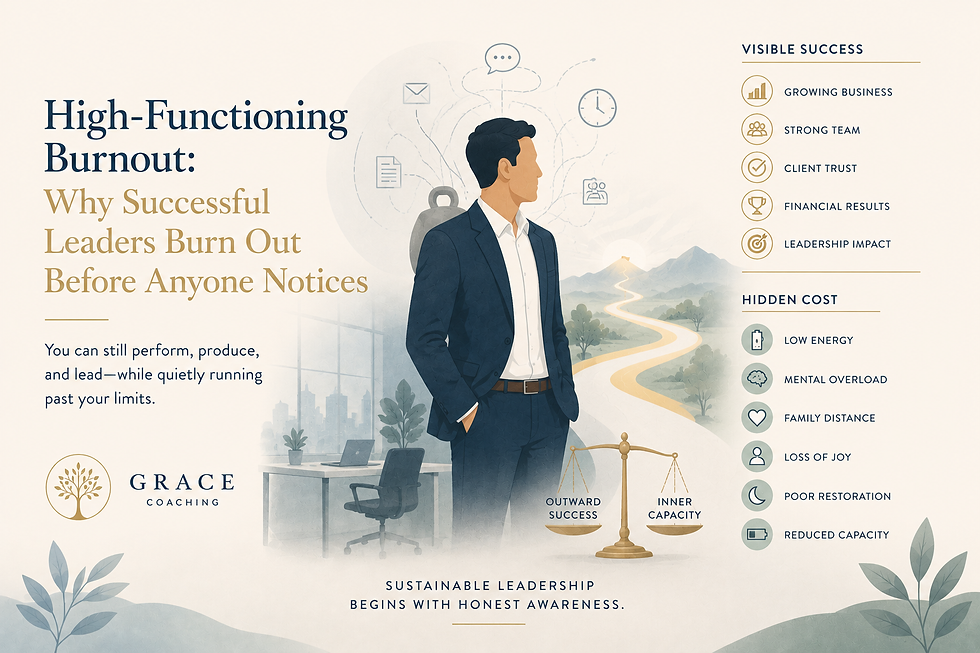
This connects with the reality of high-functioning burnout. A leader can appear successful publicly while privately losing patience, presence, health, and joy.
Self-leadership helps the leader notice the cost before the cost becomes a crisis.
Strong Leaders Are Repairable
One mark of self-leadership is repair.
Not perfection.
Repair.
A self-led leader can admit:
“I was wrong.”
“I reacted too quickly.”
“I avoided that conversation.”
“I made that harder than it needed to be.”
“I brought pressure into the room.”
“I did not listen well.”
“I need to clarify what I meant.”
“I need to change how I am carrying this.”
This kind of humility strengthens leadership.
People do not need leaders to be flawless.
They need leaders who are honest, responsible, and repairable.
In business, repair builds trust.
At home, repair restores connection.
Within the leader, repair creates growth without shame.
A leader who cannot repair is forced to defend. A leader who can repair is free to grow.
Purpose Gives Self-Leadership Direction
Self-leadership is not only about managing habits or emotions.
It is about living and leading from purpose.
A leader needs to know:
Why am I building this?
Who am I becoming through this?
What kind of impact do I want to have?
What kind of life am I trying to create?
What am I unwilling to sacrifice?
What does success mean in this season?
What would make this worth it?
Without purpose, leadership can become motion without meaning.
The leader may achieve more but feel less connected.
They may grow the business but lose joy.
They may keep moving but no longer know why.
Purpose helps the leader decide what deserves sacrifice and what does not.
It helps the leader say yes with conviction and no with peace.
It helps the leader reconnect action to meaning.
A Self-Leadership Reflection
Take a few minutes and answer these honestly.
What kind of leader do I become under pressure?
What emotion most often leads me if I am not careful?
What leadership pattern keeps repeating in my business or home?
What do I avoid because it makes me uncomfortable?
Where do I over-control because I do not fully trust?
What belief about success may be driving me too hard?
What value do I say matters, but my calendar does not yet protect?
Where do I need to repair?
Where is my current leadership costing my capacity?
Who am I becoming as I build what I am building?
These questions are not meant to create condemnation.
They are meant to create clarity.
The goal is not to become a perfect leader.
The goal is to become an honest, growing, grounded leader.
A Simple Practice: The Leadership Mirror
At the end of each week, take ten minutes and ask:
Where did I lead myself well this week?
Where did I react instead of respond?
What pressure pattern showed up?
What conversation did I avoid or handle well?
What decision did I make or delay?
Where did I live aligned with my values?
Where did I drift?
What do I need to repair, clarify, or adjust next week?
This practice helps leaders stop moving so fast that they never learn from their own patterns.
It creates a rhythm of reflection.
And reflection turns experience into wisdom.
Things to Remember
Strong leadership begins within.
Not because strategy does not matter.
Strategy matters.
Systems matter.
Communication matters.
Execution matters.
Results matter.
But the leader is not separate from any of those things.
The leader brings themselves into every decision, conversation, system, and relationship.
Their clarity affects the business.
Their emotional state affects the team.
Their identity affects their decisions.
Their values affect their priorities.
Their capacity affects their presence.
Their purpose affects their endurance.
To lead others well, the leader must learn to lead themselves first.
Not perfectly.
Honestly.
Consistently.
With humility, courage, discipline, grace, and awareness.
If you are ready to strengthen the inner work behind your leadership, explore Private Advisory to learn how Grace Coaching helps founders and executives lead themselves, their business, and their life with greater clarity and purpose.
Ready to Strengthen the Leader Behind the Leadership?
Strong leadership is not only about strategy, execution, and communication. It is also about the inner clarity, emotional steadiness, values, and capacity of the person leading.
Private Advisory helps founders and executives lead themselves, their business, and their life with greater clarity, purpose, and alignment.