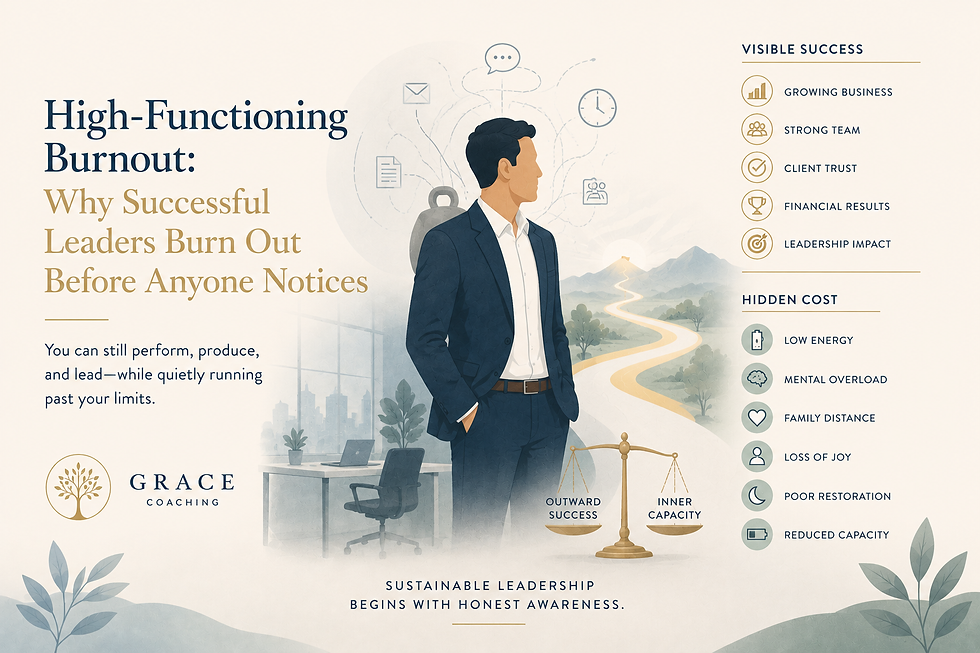
Work-Life Balance Is Not About Equal Time

Many leaders hear the phrase “work-life balance” and quietly reject it.
Not because they do not care about their life.
Not because they do not love their family.
Not because they want to be consumed by work.
But because balance sounds unrealistic.
A business owner may think:
“How am I supposed to give equal time to my business, my spouse, my children, my health, my faith, my friendships, my personal growth, and rest?”
An executive may think:
“My responsibilities are not equal, so my time cannot be equal.”
A founder may think:
“There are seasons where the business simply needs more from me.”
A parent may think:
“Even when I am home, I am still tired.”
So the word balance begins to feel like pressure.
It sounds like one more standard the leader is failing to meet.
But real balance is not about giving everything equal time.
It is about living and leading with aligned presence.
It is about making sure that the things that matter most are not consistently receiving
what is left over after everything else has taken the best of you.
Equal Time Is Not Always Possible
There are seasons when work requires more hours.
There are seasons when family requires more attention.
There are seasons when health requires more focus.
There are seasons when a business needs a push, a child needs support, a marriage needs repair, a parent needs care, or the leader needs recovery.
Life does not always divide evenly.
Trying to give every area the exact same amount of time can create guilt, frustration, and unrealistic expectations.
A leader does not need to pretend every area of life gets equal hours.
That is not how real life works.
But unequal time does not have to mean unhealthy imbalance.
The question is not:
“Did everything get the same amount of time?”
The better question is:
“Did the most important things receive the right kind of attention for this season?”
That question creates wisdom instead of guilt.
Balance Is More About Alignment Than Equality
Balance is not mathematical.
It is relational, seasonal, and values-based.
A balanced life does not mean every category receives the same number of hours.
It means your choices are aligned with your values.
It means your calendar does not consistently betray what you say matters most.
It means your family does not always receive the tired version of you.
It means your health is not endlessly sacrificed for productivity.
It means your business growth is not built on the slow erosion of your marriage, body, peace, or purpose.
It means you can work hard without losing yourself inside the work.
Balance asks:
“Is the way I am living aligned with what I claim to value?”
That question can be uncomfortable. But it is also freeing.
Because the goal is not perfect distribution.
The goal is honest alignment.
Presence Matters More Than Perfect Scheduling
Many leaders feel guilty because they cannot always be home as much as they want.
Time matters, of course. Presence cannot exist without some actual availability.
But many families are not only asking for more hours.
They are asking for more of the leader when the leader is there.
A spouse may not need every evening to be long and perfect.
They may need a few moments where the phone is down and the leader is emotionally available.
A child may not need an entire day of entertainment.
They may need ten minutes of eye contact, curiosity, laughter, and undistracted attention.
A leader may not need to spend equal time with every relationship every week.
But the people who matter most need to know that when the leader is with them, they are not competing with the business for every ounce of attention.
This is where work-life integration becomes deeply practical.
The issue is not only whether the leader is home. The issue is whether the leader is present.
Being Home Is Not the Same as Being Available
A leader can be physically home and emotionally absent.
They can sit at the table while mentally rewriting tomorrow’s agenda.
They can be in the living room while checking messages.
They can answer a child’s question while only half-listening.
They can nod through a conversation with their spouse while still carrying a business problem internally.
This is not always intentional.
Often, it is the result of pressure.
The leader’s body arrives home before the leader’s mind and heart do.
This connects directly to the way a leadership style follows you home. The leader may still be in problem-solving mode, performance mode, correction mode, or decision mode long after the workday has technically ended.
Work-life balance requires more than being in the right place.
It requires learning how to shift into the right presence.
Balance Requires Capacity, Not Just Time
Many leaders try to solve balance only through scheduling.
They block family time.
They plan date nights.
They schedule workouts.
They create time for rest.
Those are good practices.
But if the leader has no internal capacity left, the scheduled time may not become the restorative or relational experience they hoped for.
A date night with no emotional availability may feel disappointing.
A family dinner with a distracted mind may feel disconnected.
A workout with a depleted body may feel like another obligation.
A quiet evening with unresolved stress may not feel peaceful.
This is why leadership capacity matters.
Balance is not only about protecting time.
It is about protecting the quality of the leader who enters that time.
If the business consumes all mental, emotional, and physical capacity, the calendar may show “family,” “health,” or “rest,” but the leader may still be unable to fully engage.
Time creates opportunity. Capacity allows presence.
The Calendar Reveals What Is Being Protected
A leader’s calendar tells a story.
Not the whole story, but an honest one.
It reveals what gets protected.
It reveals what gets pushed.
It reveals what receives preparation.
It reveals what gets leftovers.
It reveals where the leader is reactive and where the leader is intentional.
Many leaders say family matters most, but family time is the first thing moved when work expands.
They say health matters, but exercise and rest are treated as optional.
They say spiritual life matters, but stillness only happens when everything else is finished.
They say marriage matters, but meaningful conversation is postponed until there is a crisis.
This is not about shame.
Every leader has seasons where something important gets squeezed.
But if the same things are always squeezed, that is no longer only a busy season.
It is a pattern.
Balance requires noticing the pattern and asking:
“What am I consistently failing to protect?”
The Myth of “When Things Calm Down”
Many leaders tell themselves:
“When things calm down, I will be more present.”
“When the business stabilizes, I will focus on my marriage.”
“When this season ends, I will get healthy again.”
“When the team improves, I will take more time off.”
“When revenue is stronger, I will slow down.”
Sometimes a temporary push is necessary.
But many leaders are waiting for a calm season that never arrives.
The business grows, but the pressure grows too.
The team expands, but the decisions continue.
Revenue improves, but expectations rise.
The children get older, but their needs change instead of disappear.
Life does not become perfectly calm.
A leader must learn to build alignment inside real life, not only after life becomes easier.
This is one reason high-functioning burnout often develops. The leader keeps postponing recovery, connection, and alignment until some future season that never fully comes.
Balance Requires Saying No to Good Things
One of the hardest parts of balance is not saying no to bad things.
It is saying no to good things that do not belong in this season.
A good opportunity may still be a distraction.
A good client may still cost too much capacity.
A good project may still pull the leader away from a better priority.
A good event may still come at the wrong time.
A good idea may still need to wait.
Many leaders are overextended not because they are choosing terrible things, but because they are saying yes to too many good things.
Balance requires discernment.
The question is not only:
“Is this good?”
The question is:
“Is this mine to carry now?”
That question helps leaders protect alignment.
Family Should Not Only Get the Leftovers
Many leaders work hard because they love their family.
They want to provide.
They want to create security.
They want to build opportunities.
They want to make life better.
That motive matters.
But the people we love need more than the results of our work.
They need us.
Not the exhausted version only.
Not the distracted version only.
Not the irritated version only.
Not the version who collapses after giving the best energy elsewhere.
This is one of the painful tensions of leadership.
A leader may be working for the family while unintentionally becoming less available to the family.
This does not mean the leader is failing.
It means the leader needs to examine the cost of the current rhythm.
Provision matters.
Presence matters too.
A healthy life does not force those two to become enemies forever.
A Balanced Season May Still Be Uneven
A healthy season may not look equal.
A business launch may require more hours for a short time.
A family crisis may require work to take a back seat.
A health issue may require the leader to slow down.
A child’s important season may require greater attention.
A marriage repair season may require emotional priority.
The question is not whether every season is evenly distributed.
The question is whether the unevenness is honest, intentional, communicated, and temporary.
There is a difference between saying:
“This season will require more work for the next six weeks, and here is how I will protect family connection during it.”
And simply disappearing into work with no conversation, no boundary, and no return plan.
There is a difference between a temporary sacrifice and an undefined pattern.
Temporary sacrifice can be healthy when it is chosen wisely and communicated clearly.
Undefined sacrifice becomes resentment, distance, and burnout.
Balance Requires Communication
Work-life balance is not only a personal time-management issue.
It is also a communication issue.
A spouse may be more supportive of a demanding work season when they understand the reason, the timeline, the plan, and how connection will be protected.
A team may respect boundaries more when expectations are communicated clearly.
Children may feel more secure when the leader is intentional with the time they do have.
A leader may feel less internal conflict when they stop carrying silent guilt and start creating honest agreements.
Balance does not happen only in the calendar.
It happens in conversations.
For example:
“This next month will be demanding at work, but I do not want us to disconnect. Can we protect Friday night together?”
“I know I have been distracted in the evenings. I want to change how I transition home.”
“I need to adjust my schedule because my health has been too low on the priority list.”
“I cannot take on that project right now without sacrificing commitments I need to protect.”
“I want to talk about what this season is costing us and what needs to change.”
These conversations may feel uncomfortable, but they create alignment.
Balance Is Built Through Rhythm
Balance is not usually created by one dramatic change.
It is built through rhythm.
A morning rhythm that grounds the leader.
A work rhythm that protects deep focus.
A meeting rhythm that reduces reactive interruptions.
A family rhythm that creates predictable connection.
A recovery rhythm that restores the body.
A communication rhythm that keeps marriage and team expectations clear.
A spiritual rhythm that reconnects the leader to purpose and humility.
Without rhythm, the leader is constantly reacting.
With rhythm, the leader creates structure around what matters.
This does not make life perfect.
But it creates a stronger container for leadership and life to coexist in a healthier way.
A Simple Work-Life Alignment Audit
Take a few minutes and answer these questions honestly.
What do I say matters most?
What does my calendar say matters most?
Where is there a gap between the two?
Who or what consistently gets my best energy?
Who or what consistently gets my leftovers?
What important area of life have I been postponing until “things calm down”?
Where am I physically present but emotionally unavailable?
What good thing may need a no in this season?
What rhythm would help me protect what matters?
What conversation do I need to have with my spouse, family, team, or myself?
These questions are not about creating guilt.
They are about creating alignment.
A Better Definition of Balance
Here is a better way to think about work-life balance:
Balance is the ongoing practice of aligning your time, energy, presence, and responsibilities with what matters most in the season you are in.
That definition is more realistic.
It allows for seasons.
It includes responsibility.
It honors the demands of leadership.
But it also refuses to let work consume every other part of life indefinitely.
Balance is not perfect equality. It is wise alignment.
Things to Remember
Work-life balance is not about equal time.
It is about aligned presence.
It is about knowing what matters most and making sure those things do not consistently receive what is left after everything else has taken the best of you.
It is about working hard without losing the people you are working for.
It is about leading the business without disappearing from your own life.
It is about building success in a way that does not quietly bankrupt your health, Peace, marriage, family, or purpose.
Some seasons will be uneven.
Some weeks will be demanding.
Some responsibilities will require sacrifice.
But sacrifice should be honest, intentional, communicated, and connected to a healthier rhythm.
If your life has started to feel out of alignment, the answer may not be guilt.
It may be redesign.
It may be clearer boundaries.
Better rhythms.
More honest conversations.
Stronger recovery.
Greater capacity.
A more intentional way of leading both the work and the life behind the work.
If you are unsure where leadership pressure is affecting your balance, take the Leadership Capacity Assessment to identify what may need attention next.
Is Your Success Still Aligned With the Life You Want?
Work-life balance is not about giving everything equal time. It is about making sure your time, energy, and presence are aligned with what matters most.
Take the Leadership Capacity Assessment to identify where leadership pressure may be affecting your business, health, relationships, and ability to lead with clarity.