Grace Is Not Weakness in Leadership

Many leaders misunderstand grace.
They think grace means being soft.
Letting things slide.
Avoiding hard conversations.
Lowering standards.
Excusing poor behavior.
Refusing to hold people accountable.
Being nice when strength is needed.
But that is not grace.
That is avoidance.
Real grace is not weakness.
Grace is the ability to tell the truth without shame.
It is the ability to hold a standard without humiliating the person.
It is the ability to correct without condemning.
It is the ability to grow without self-punishment.
It is the ability to face what is real without losing hope.
In leadership, grace is not the absence of strength.
Grace is strength governed by wisdom, humility, and love.
Grace Does Not Remove Truth
Some leaders avoid grace because they think it will make them less honest.
They believe that if they are gracious, they will not be direct enough.
But real grace does not remove truth.
Grace makes truth safer to face.
A leader without truth becomes unclear.
A leader without grace becomes harsh.
Strong leadership requires both.
Truth says:
“This needs to change.”
Grace says:
“You are not beyond growth.”
Truth says:
“This standard matters.”
Grace says:
“We can address this without shame.”
Truth says:
“This behavior has consequences.”
Grace says:
“Your mistake does not have to become your identity.”
Truth without grace can crush people. Grace without truth can confuse people.
Together, they create the conditions for real growth.
Grace Is Not the Same as Avoidance
Avoidance refuses to name the problem.
Grace names the problem with the right spirit.
Avoidance says:
“I do not want to deal with this.”
Grace says:
“I care enough to address this well.”
Avoidance protects comfort.
Grace protects dignity.
Avoidance allows issues to grow in the dark.
Grace brings issues into the light without turning the light into a weapon.
This distinction matters because many leaders mistake their avoidance for kindness.
They say nothing because they do not want to hurt someone.
They tolerate repeated issues because they do not want conflict.
They soften the message until it loses meaning.
They delay the conversation until frustration builds.
But avoidance often creates more pain later.
Grace does not avoid truth. Grace tells the truth in a way that gives people a path forward.
Grace Holds Standards Without Shame
Strong leaders need standards.
Standards protect quality.
They protect trust.
They protect culture.
They protect clients.
They protect the team.
They protect the mission.
Grace does not ask leaders to abandon standards.
It asks leaders to hold standards without shame.
There is a difference between saying:
“This result did not meet the standard, and we need to correct it.”
And saying:
“You always mess this up. I cannot believe I have to keep explaining this.”
One addresses the issue.
The other attacks the person.
One invites ownership.
The other creates defensiveness.
One protects the standard.
The other damages trust.
A gracious leader can be firm.
They can say no.
They can correct.
They can confront.
They can make hard decisions.
But they do not use shame as a leadership tool.
Shame may create short-term compliance, but it rarely creates healthy ownership.
Grace helps people face responsibility without feeling destroyed by it.
Grace Builds Ownership
Some leaders believe people only take ownership when pressure is high and grace is low.
But fear-based ownership is fragile.
People may perform because they are afraid of being criticized, embarrassed, or rejected.
They may hide mistakes.
They may avoid risks.
They may tell the leader what they think the leader wants to hear.
They may comply outwardly while disconnecting inwardly.
Grace creates a different environment.
When grace is present, people can tell the truth earlier.
They can admit mistakes more quickly.
They can ask for help without feeling weak.
They can receive correction without collapsing.
They can take responsibility without drowning in shame.
This does not mean there are no consequences.
It means consequences are handled with clarity and dignity.
A gracious culture does not lower responsibility. It makes responsibility more honest.
Grace Begins With the Way a Leader Leads Themselves
Many leaders are harsh with others because they are harsh with themselves.
They live under constant internal pressure.
They tell themselves:
“I should be further along.”
“I should have known better.”
“I cannot afford to fail.”
“I have to hold everything together.”
“I cannot let anyone see weakness.”
“If I slow down, I am falling behind.”
That inner harshness eventually leaks into leadership.
It affects tone.
It affects patience.
It affects expectations.
It affects communication.
It affects how mistakes are handled.
A leader who has not learned grace internally may struggle to extend it externally.
This is why lead yourself first matters.
The way a leader relates to themselves under pressure shapes the way they relate to others under pressure.
A leader who can face their own growth without shame becomes better equipped to help others grow without shame.
Grace Allows Honest Self-Correction
Some leaders fear that if they give themselves grace, they will become complacent.
They think self-criticism is what keeps them sharp.
But constant self-condemnation does not always create better leadership.
Sometimes it creates exhaustion.
Defensiveness.
Avoidance.
Perfectionism.
Fear of failure.
Inability to rest.
Over-identification with performance.
Grace does not say:
“Everything is fine.”
Grace says:
“Tell the truth, then take the next right step.”
Grace allows a leader to say:
“That was not my best response.”
“I need to repair that conversation.”
“I avoided what needed to be addressed.”
“I overreacted because I was carrying too much.”
“I need to make a change.”
“I can learn from this without hating myself.”
That is not weakness.
That is mature self-leadership.
Growth rooted in shame often becomes brittle.
Growth rooted in grace becomes more sustainable.
Grace Helps Leaders Repair
Every leader makes mistakes.
They say something too sharply.
They avoid a conversation too long.
They make a decision too quickly.
They miss something important.
They bring pressure into a room.
They fail to listen well.
They disappoint someone.
The question is not whether a leader will ever fail.
The question is whether the leader can repair.
Grace makes repair possible.
A leader who believes mistakes equal failure may defend, deny, blame, or minimize.
A leader who understands grace can take ownership without collapsing.
They can say:
“I was wrong.”
“I did not handle that well.”
“I need to correct something.”
“I brought pressure into that conversation.”
“I should have listened before I responded.”
“I want to repair this.”
Repair is one of the strongest forms of leadership.
It tells people:
“I am responsible for my impact.”
“I am still growing.”
“Truth matters here.”
“Trust matters here.”
“Pride will not lead this relationship.”
That kind of humility creates safety and respect.
Grace Makes Accountability Healthier
Accountability without grace often becomes fear.
Grace without accountability often becomes confusion.
Healthy leadership brings them together.
Grace says:
“You are human.”
Accountability says:
“You are responsible.”
Grace says:
“Mistakes can become learning.”
Accountability says:
“Patterns still need to change.”
Grace says:
“I will not shame you.”
Accountability says:
“I will not ignore this.”
Grace says:
“You have dignity.”
Accountability says:
“Your choices matter.”
This combination is powerful.
It allows leaders to address real issues without creating unnecessary emotional damage.
It allows people to grow without pretending everything is okay.
It allows teams to be honest without becoming careless.
Grace and accountability are not enemies. Together, they build mature ownership.
Grace Helps Leaders Stay Human
Leadership can slowly train people to hide their humanity.
Leaders may feel pressure to always know.
Always decide.
Always be strong.
Always have energy.
Always be confident.
Always carry the room.
Always be available.
Always handle it.
But leaders are still human.
They have limits.
They have emotions.
They have needs.
They have blind spots.
They have fears.
They have bodies that require rest.
They have relationships that need attention.
They have souls that need meaning.
Grace helps leaders stay honest about their humanity without using it as an excuse.
It allows a leader to say:
“I have limits, so I need wisdom.”
“I am tired, so I need recovery.”
“I am uncertain, so I need counsel.”
“I made a mistake, so I need repair.”
“I am under pressure, so I need to slow down before I respond.”
This kind of honesty does not reduce leadership.
It deepens it.
Grace Is Necessary for Sustainable Growth
Many high-achievers grow through pressure.
They push themselves.
They set high expectations.
They demand more.
They measure progress.
They pursue excellence.
There is value in discipline.
But discipline without grace can become punishing.
A leader may grow externally while becoming internally exhausted.
They may achieve more while enjoying less.
They may produce results while losing peace.
They may lead others while becoming increasingly disconnected from themselves.
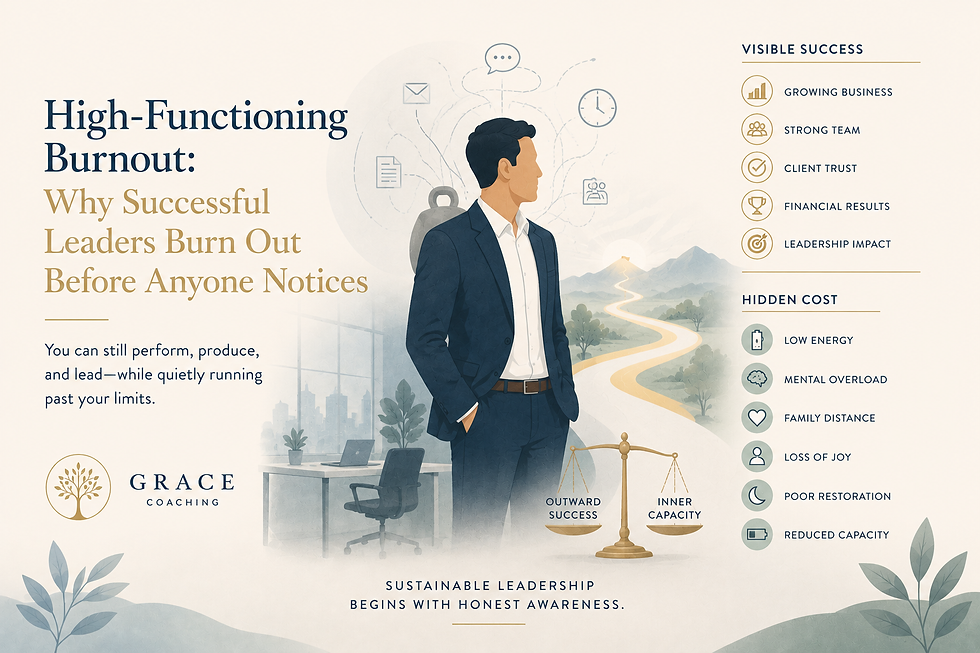
This connects to high-functioning burnout. A leader can keep performing while quietly running past their limits because they do not know how to tell the truth about their own humanity.
Grace allows growth to continue without requiring self-destruction.
It helps leaders pursue excellence without making exhaustion the proof of commitment.
It helps them admit limits without feeling like failures.
It helps them recover without guilt.
It helps them change without shame.
Grace Strengthens Difficult Conversations
Grace does not make hard conversations disappear.
It makes them healthier.
A gracious leader can still be direct without being harsh.
They can say:
“This needs to be addressed.”
“This pattern cannot continue.”
“This decision has consequences.”
“This standard matters.”
“This is not aligned with who we are.”
But they can say it in a way that protects the dignity of the person.
Grace shapes tone.
It shapes timing.
It shapes posture.
It shapes the goal of the conversation.
The goal is not to win.
Not to shame.
Not to overpower.
Not to release frustration.
The goal is clarity, responsibility, repair, and growth.
That kind of communication requires strength.
It is often easier to attack or avoid. Grace takes more maturity.
Grace Does Not Mean Everyone Stays
Grace does not mean a leader never makes hard decisions.
Sometimes a person still needs to be removed from a role.
Sometimes a client relationship still needs to end.
Sometimes a boundary still needs to be enforced.
Sometimes trust has been broken and consequences are necessary.
Sometimes repeated behavior shows that someone is not willing or able to carry the responsibility.
Grace does not erase consequences.
But grace changes how consequences are handled.
A gracious leader does not have to dehumanize someone in order to make a hard decision.
They do not need hatred to create a boundary.
They do not need contempt to end a working relationship.
They do not need shame to protect the business.
They can be clear, firm, and humane.
That is strong leadership.
Grace Creates a Healthier Culture
The way leaders handle mistakes shapes culture.
If mistakes are met with shame, people hide.
If questions are mocked, people stop asking.
If correction is harsh, people become defensive.
If leaders never admit fault, people learn image management.
But if mistakes are handled with truth and grace, people learn honesty.
They learn that responsibility matters.
They learn that growth is possible.
They learn that standards are real.
They learn that people are not disposable because they are imperfect.
A gracious culture is not careless.
It may actually become more accountable because people are less afraid to tell the truth.
Grace creates the kind of environment where people can face reality and grow.
A Reflection for Leaders
Take a few minutes and answer honestly:
Where have I confused grace with weakness?
Where have I used harshness because I was afraid grace would lower the standard?
Where have I avoided a conversation and called it kindness?
Where do I need to hold a standard without shame?
Where am I harsh with myself in a way that eventually affects others?
Where do I need to repair?
Where do I need to offer grace without removing responsibility?
Where do I need to receive grace so I can keep growing?
What would it look like to lead with both truth and humanity?
These questions are not meant to soften your leadership into passivity.
They are meant to strengthen your leadership with maturity.
A Simple Grace-Based Leadership Practice
The next time you need to address a mistake, missed expectation, or difficult issue, pause and ask four questions:
1. What is the truth?
Name the issue clearly.
2. What is the standard?
Clarify what matters and why.
3. What is the human reality?
Consider the person, context, pressure, misunderstanding, or growth opportunity involved.
4. What is the next responsible step?
Define what needs to happen now.
This practice helps leaders avoid two extremes.
It prevents avoidance because the truth and standard are named.
It prevents harshness because the human reality is considered.
Grace does not replace responsibility. It helps responsibility become redemptive rather than destructive.
Things to Remember
Grace is not weakness in leadership.
Grace is not avoidance.
Grace is not lowering the standard.
Grace is not pretending everything is fine.
Grace is not refusing accountability.
Grace is the strength to tell the truth without shame.
The courage to hold standards without contempt.
The humility to repair when you are wrong.
The wisdom to correct without crushing.
The maturity to grow without self-punishment.
The ability to remember that people are human, including you.
Leadership without grace often becomes harsh, fearful, defensive, or exhausting.
Grace without leadership can become vague and passive.
But grace joined with truth creates something powerful.
A leadership style that is clear and humane.
Strong and humble.
Accountable and hopeful.
Honest and restorative.
This is the kind of leadership that builds trust, protects standards, develops people, and allows the leader to keep growing too.
If you are ready to lead with greater truth, strength, humility, and grace, explore Private Advisory to learn how Grace Coaching helps founders and executives lead themselves, their business, and their relationships with deeper clarity and purpose.
Lead With Strength, Truth, and Grace
Grace is not the opposite of accountability. It is what allows leaders to tell the truth, hold standards, repair trust, and grow without shame.
Private Advisory helps founders and executives lead themselves, their business, and their relationships with greater clarity, humility, and strength.